
Checking Criminal History in St. Augustine Beach
Start with the custodian that created the record. SABPD holds reports made by its officers. SJSO holds booking and county custody data. The St. Johns County Clerk holds the filed court case, and FDLE maintains statewide person-linked history. Give the full name, approximate date, location, and any report, arrest, or case number. A St. Augustine Beach record search is most reliable when each source is used for its own part of the event.
- Request the city police report through SABPD NextRequest or its records custodian.
- Use phone, email, fax, mail, or the weekday counter if the portal is unavailable.
- Check SJSO Booking for current custody and bond after a custodial arrest.
- Search the Clerk's Benchmark docket for filed charges and the final disposition.
- Use FDLE for a Florida-wide public search or personal fingerprint review.
St. Augustine Beach A1A Counters
Two nearby addresses serve different records. SABPD is at 2300 A1A South and handles police reports. The City Clerk is at 2200 A1A South and handles general municipal records through records@cityofsab.org or (904) 471-2122. Sending a police narrative request to the general city counter can add an avoidable handoff, while asking police for a City Council or finance file starts at the wrong office.
Use SABPD for incident, arrest, and protected crash materials. Use the City Clerk for broader city business. Neither office replaces SJSO Booking or the county Clerk's criminal docket.
St. Augustine Beach Police Department Records
SABPD is at 2300 A1A South, St. Augustine Beach, Florida 32080. Call (904) 471-3600, fax (904) 471-0737, or email contact@sabpd.org. Administrative Manager Jackie Parrish is identified as the police records custodian, and FDLE lists Chief Daniel P. Carswell. The weekday records counter operates from 8:00 a.m. to 5:00 p.m.
NextRequest, email, phone, fax, mail, and the counter are available. SABPD asks requesters to allow seven to ten business days. Police crash records have a distinct rule during the protected period: the requester needs valid identification and a Traffic Sworn Statement. That condition should not be generalized to every city public-record request.
Use the St. Augustine Beach PDF
The general city form asks for the request date, requester name, phone, email, and a narrative of the research sought. It suggests including an address, AK number, owner, dates, or other facts that narrow the search. Office-use fields track completion, staff time, research charges, and page, media, or large-copy totals. The form does not state an ID, notary, or turnaround requirement.
This PDF is a useful fallback when an online portal cannot be used, but choose the correct custodian first. A police report still belongs with SABPD, while a general city file belongs with the City Clerk.
St. Augustine Beach Arrests and Bookings
A custodial SABPD arrest is booked through St. Johns County rather than a separate beach jail. SJSO creates fingerprints, a photograph, booking and custody dates, booked charges, bond, and release information. SABPD retains the officer's report and probable-cause narrative. The Clerk later records any filed prosecution.
The SJSO inmate page was temporarily down on the research date. Call Booking at (904) 209-3125 for current custody or bond, request booking material from SJSO, and search Benchmark for the later case. Because each stage is independent, a new St. Augustine Beach arrest can appear in custody records before the court docket.
Trace a St. Augustine Beach Arrest
First confirm the arresting agency. A beach location does not prove SABPD authored the report because SJSO, FHP, or another agency may act there. Second, contact SJSO Booking for current status. Third, request the narrative from the actual arresting agency. Finally, search the Clerk for the charge the State Attorney filed and the court's outcome.
The arrested charge can differ from the filed charge, and both can differ from the final disposition. Match records with a full name, birth date when accepted, dates, and report or case numbers rather than relying on name alone.
Municipal Court Records in St. Augustine Beach
St. Augustine Beach has no standalone municipal criminal court. Criminal and ordinance matters that reach court go through St. Johns County Court and the county Clerk. Parking citations begin with City Finance at 2200 A1A South, so a timely paid ticket ordinarily remains a city record rather than a Benchmark court case.
| Court Name | St. Johns County Court, with no separate beach municipal criminal court |
|---|---|
| Case Types Heard | Misdemeanors, criminal traffic, and forwarded city ordinance matters |
| Case Lookup Channel | Clerk Benchmark search, public terminal, or records request |
| What the Docket Shows | Filed charges, events, documents, disposition, judgment, and sentence |
| Copies & Fees | Online images may be free; paper copies cost $1 per page and certification costs $2 per document |
St. Augustine Beach's 30-Day Hand-Off
A parking citation is due to City Finance within 30 days. If it is contested, unpaid, or forwarded, it can move to the Clerk and County Court. This timeline matters because searching the county docket too soon can produce no result even though the city ticket exists. Begin at 2200 A1A South for a routine citation, then use the Clerk when the matter has crossed into court.
The city payment file and county judicial file are not duplicate databases. One shows the local citation process; the other begins after a referral that creates a court event.
Where St. Augustine Beach Records Go
SABPD creates its incident and arrest reports. SJSO creates county booking and custody records. The Clerk maintains the filed criminal case and disposition. Required arrest and court reporting reaches FDLE's central repository. Each database has a different unit of record, so a report number, booking number, case number, and FDLE person-linked history should not be treated as the same file.
Record flow: St. Augustine Beach Police Department › St. Johns County Courts › Florida Department of Law Enforcement
Use city sources for the police narrative, county sources for custody and court outcome, and FDLE for a Florida-wide history. FDLE's public name search costs $24, with the Instant Search card charge currently adding $1. Personal Review is a separate, free fingerprint-supported route for checking one's own record accuracy.
St. Augustine Beach Copy Costs
The general city form lists 15 cents for a single-sided page and 20 cents for a double-sided page. USB, DVD, and large-document charges use actual cost, while special staff research is itemized. Those are city form terms, not a promise about Clerk certification or an SABPD crash report. Ask the correct office for an estimate when research time or special media may add cost.
A precise St. Augustine Beach request helps staff separate responsive records from unrelated files and makes a cost estimate more useful. Keep a copy of the request and any estimate or clarification.
St. Augustine Beach Island Context
St. Augustine Beach incorporated in 1959, became a city in 1978, and covers about 2.5 square miles on Anastasia Island, about five miles southeast of St. Augustine. Its compact coastal geography does not merge the city police, county jail, and court systems. Ocean Hammock Park preserves more than 18 acres from A1A Beach Boulevard toward the Atlantic, another reminder that locations in city limits still produce records at different government levels.
The city's 1964 beach wade-ins were part of the civil-rights campaign leading toward the Civil Rights Act and are commemorated locally. That history is a public-safety milestone, not a substitute for present-day incident statistics. No city crime total is invented because extractable official agency totals were not available from FDLE's interactive interface.
Match St. Augustine Beach Records
Each stage supplies its own identifier. An SABPD incident report may show an agency report number, location, date, officer, narrative, and alleged offense. An SJSO booking entry uses a booking number and focuses on intake, custody, booked charges, bond, and release. The Clerk assigns a court case number and tracks filed charges, hearings, orders, judgment, and sentence. FDLE assembles reported Florida events around a person rather than around one beach incident.
Use an exact number when possible. If no number is known, combine the legal name with date of birth where accepted, a narrow event date, location, and the agency involved. Do not treat a common-name match as confirmation. A very recent St. Augustine Beach arrest may have a booking entry before the State Attorney files a charge. A charge can also change between arrest, filing, and disposition. Calling the Clerk can clarify whether a filing delay or search mismatch explains an empty Benchmark result.
If one's own FDLE history appears wrong, Personal Review uses fingerprints and provides a challenge process at no FDLE fee. A problem in an SABPD report should be raised with SABPD, and a docket issue should be raised with the Clerk. Correction starts with the office that created the source entry.
Timing often explains an apparent gap. SABPD first documents the event, SJSO books a custodial arrest, and the State Attorney decides what charge to file. Benchmark may not show a case during that interval. Even after filing, the arrest allegation can differ from the prosecutor's count, and a plea, dismissal, or verdict can produce a different final result. Compare dates and read each docket count through disposition before drawing a conclusion from the first label found.
Historic court material has a separate limit. St. Johns County's online index generally covers computerized records from the 1990s forward. Older criminal files may require a Watson Judicial Center terminal or a Clerk research request. Give the Clerk a full name, birth date, likely date range, and case number if known. If the document sought is the beach officer's narrative rather than a filed court paper, send the request to SABPD instead. The city report and county docket remain separate even when both concern one incident.
For current custody, use SJSO Booking rather than the state prison locator. FDC Offender Search becomes relevant only when a sentence enters state prison or felony supervision. This sequence prevents a blank FDC result from being mistaken for proof that no St. Augustine Beach arrest or county case exists.
St. Augustine Beach Municipal Sources
The official city source provides municipal context and the assigned city image.
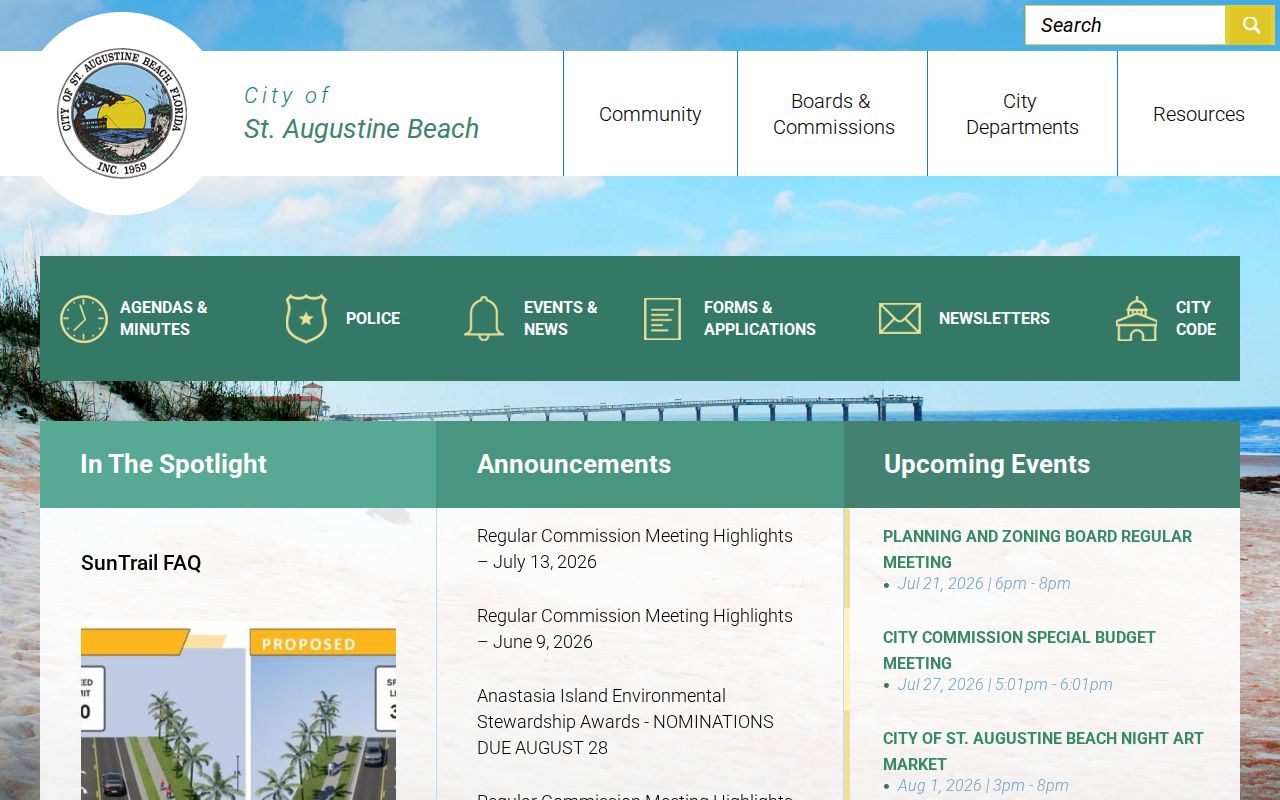
The municipal offices are a starting point for city files, while police reports belong at 2300 A1A South and criminal cases belong with the county Clerk.
The Census QuickFacts source supplies the assigned population-context image.
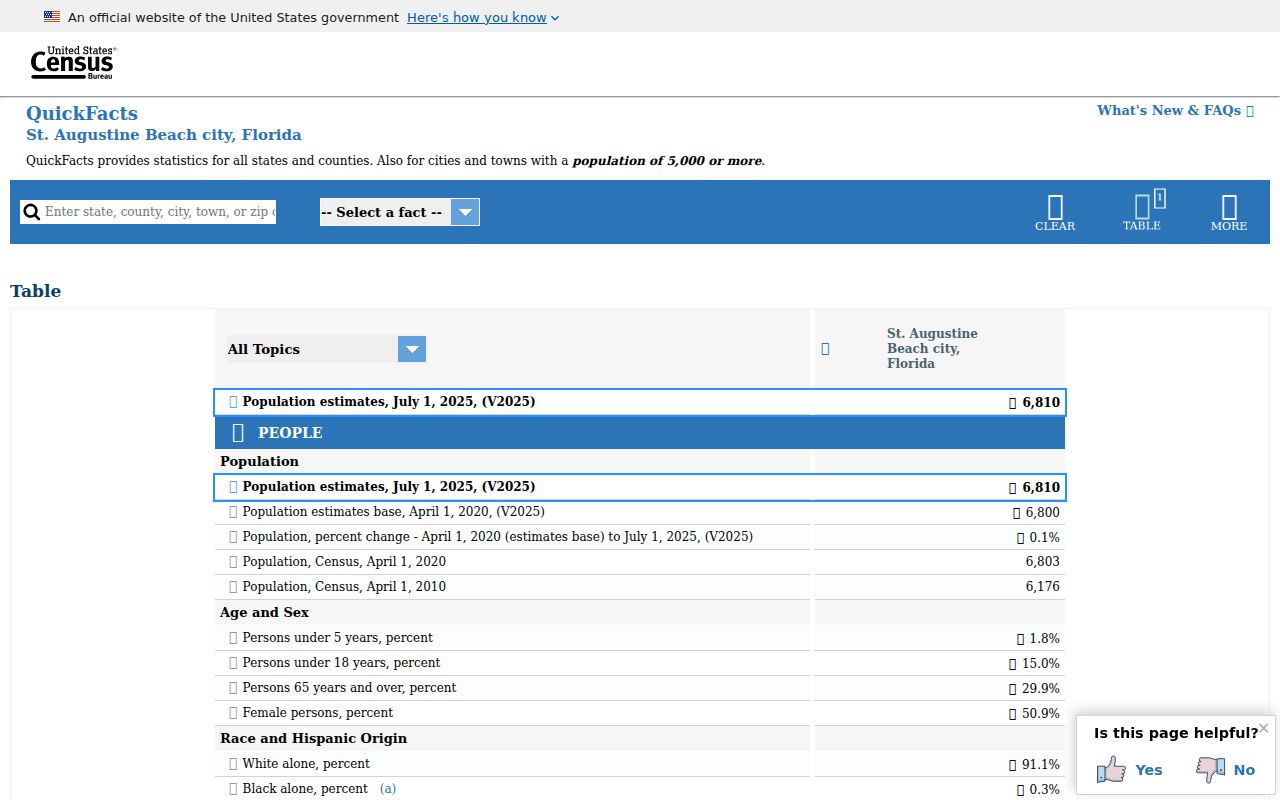
The official demographic source helps place the small island city in context without making unsupported claims about local offense counts.
The official St. Augustine Beach Police source provides the assigned department image and confirms the local report custodian.
The police source belongs at the start of an incident-report request, while SJSO and the Clerk remain the next stops for custody and prosecution.
Public Access Rules in St. Augustine Beach
Florida Public Records Law applies to city and police records, subject to specific exemptions. Active investigations, protected victims, juveniles, security information, sealed or expunged files, and confidential identifiers can limit access. Crash reports have their own protected period. Ask the custodian to cite the basis for a redaction or withholding, and do not infer that a missing online file is legally secret without checking the responsible office.
Key Statutes:
Florida Statutes chapter 119 provides the central public-record framework and exemptions.
Florida Statutes § 943.053 governs criminal-justice information dissemination.
Florida Statutes § 943.056 supports personal review and challenge of one's own state record.