
Sex Offender Checks in St. Johns County
The official starting point is the Florida Sexual Offenders and Predators Search. FDLE lets a reader search statewide or narrow the result set to St. Johns County. Name, city, county, and ZIP searches serve different needs. A name works best when the person is known. A county filter gives broader community context, while an address-radius search focuses on a place that matters to a family.
FDLE also offers campus, email or Internet-identifier searches, a public data file, printable flyers, and free alerts. The registry is updated through reports from registrants, courts, corrections agencies, and law enforcement. It should be read with care. A record can list more than one address type, and a received date tells when FDLE obtained that address information. That date is more useful than an assumption that every field was verified on the day of the search.
The FDLE registry landing page lays out the official search modes.
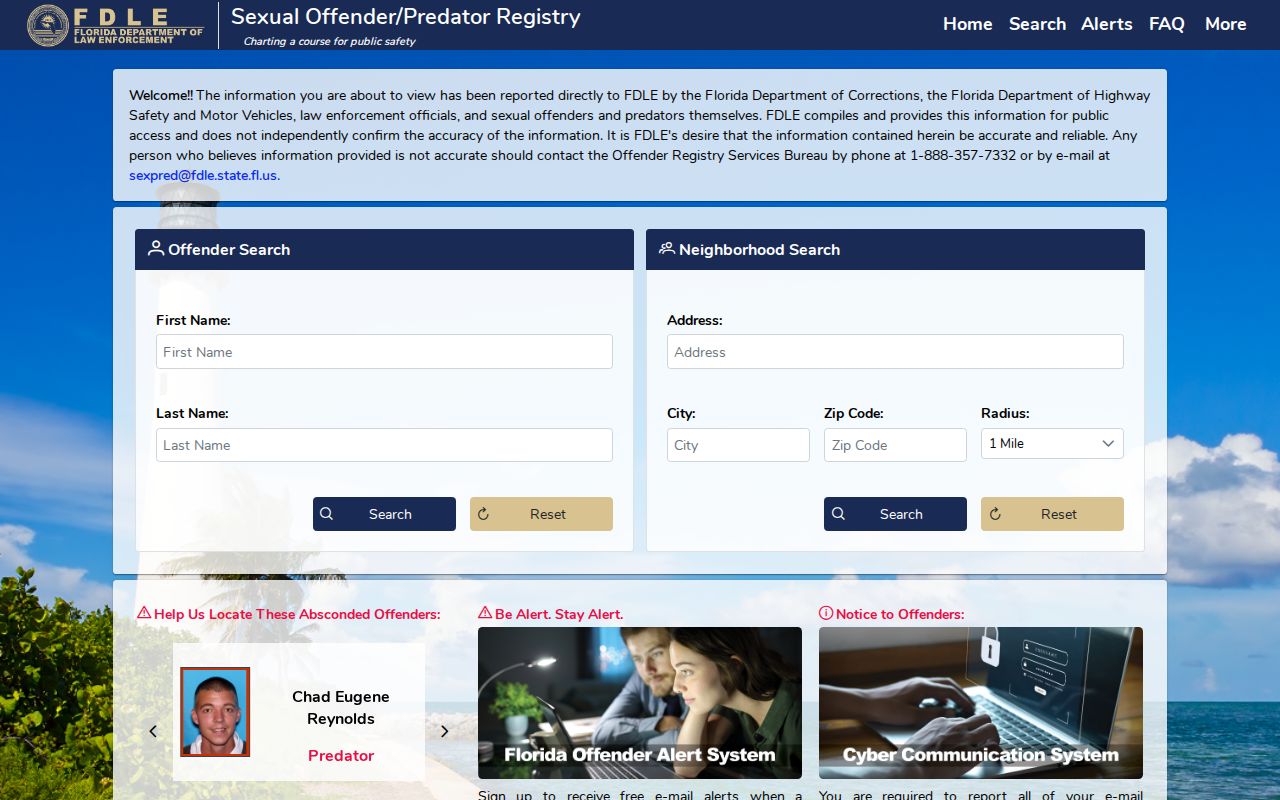
Its separate tools help readers choose a person search, location search, data file, or notification option.
St. Johns Registry Labels Explained
Florida does not publish a SORNA-style Tier I, II, or III risk score. FDLE expressly cautions that a registry listing does not state a person's risk level. The terms sexual offender and sexual predator are legal categories based on Florida statutes and court action, not informal ratings chosen by a search site.
A sexual-predator label requires qualifying statutory facts and a written court designation, or a qualifying civil commitment. It is not another word for each person in the St. Johns County sex offender registry. Searchers should use the designation shown on the profile and avoid drawing conclusions that the public record does not support.
How to Search the Florida Sexual Offenders and Predators Search
The FDLE Offender Registry Services Bureau manages the free search. Partial names are accepted, so a careful search can start broadly and then narrow by St. Johns County, a city, or a five-digit ZIP. Optional controls expose status and offender-type filters. Results can include thumbnail images and aliases when those boxes are selected.
- Open the FDLE registry and choose the name or geography search that fits the question.
- Enter a partial name, city, county, or ZIP, then expand More Options only when a status or category filter helps.
- Compare the result name, photograph, status, address, aliases, and address-source information before selecting a row.
- Open the full flyer, check dates and jurisdiction details, then use Track Offender or an address alert when ongoing notice is useful.
| Field Label | Type | Required | Notes |
|---|---|---|---|
| First and Last Name | Text | One search key needed | Partial names are accepted |
| City or ZIP Code | Text | Optional | City may be the sole geography input; ZIP uses five digits |
| County | Dropdown | Optional | Select St. Johns for countywide results |
| Offender Type and Status | Dropdown and checkboxes | Optional | Includes offender or predator and current status choices |
| Address and Radius | Address/map search | Address needed | Finds registered locations within a chosen distance |
The FDLE name-search screen shows these fields and the result controls. The official form makes a county search possible without supplying a private person's name.
That search screen is the practical gateway for St. Johns County results, aliases, status filters, and printable records.
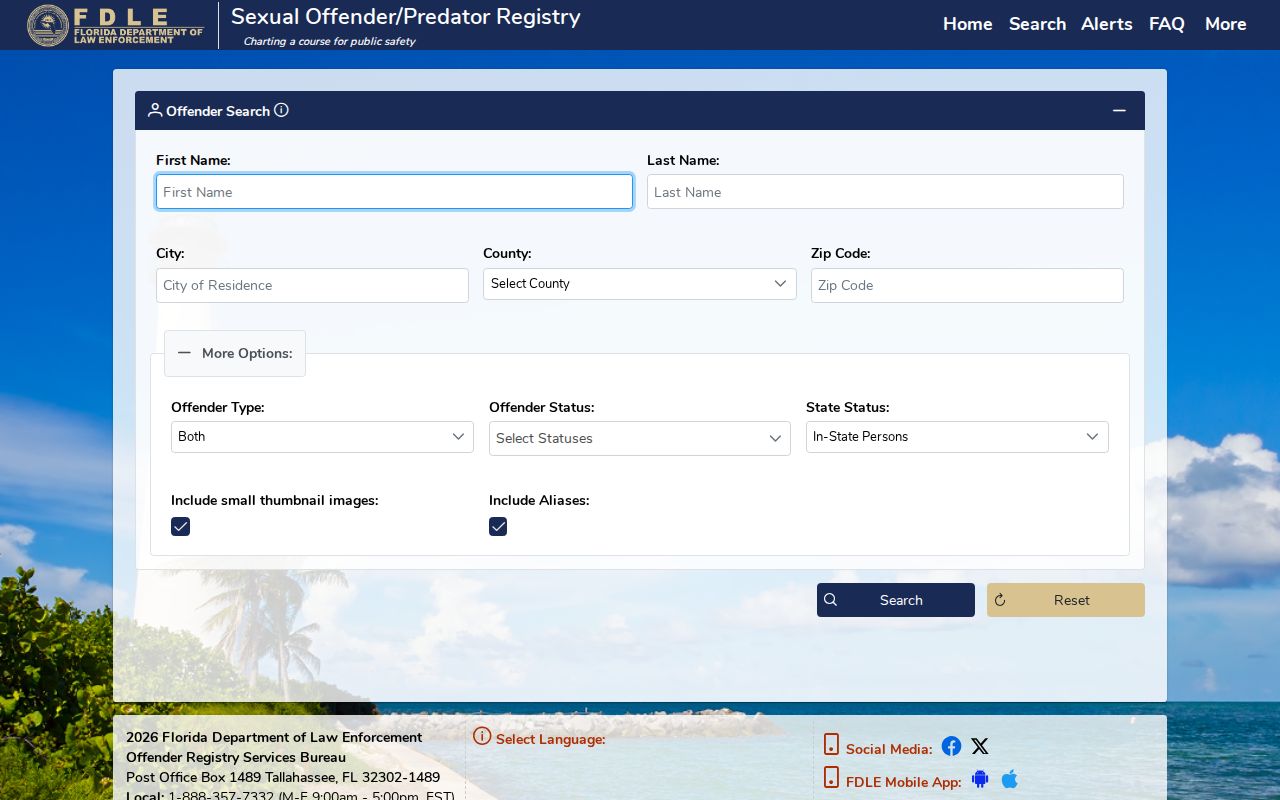
The visible fields show why a county filter can work even when no full name is known.
St. Johns Address and Person Alerts
FDLE separates two kinds of ongoing notice. An address alert follows a place and triggers when a registrant moves within a chosen distance. Track Offender follows one selected registrant and sends notice when that person moves within Florida. The first tool supports awareness near a home, school route, or other regular destination. The second is useful only after the correct profile has been matched.
These choices are not interchangeable. An address alert may identify new nearby registrations, while individual tracking will not show every change around a location. Both depend on information reaching the registry. Searchers should still open the current profile and read its permanent, temporary, transient, or confinement address type instead of relying on an old alert alone.
Inside a St. Johns Registry Profile
A public flyer brings identity, location, offense, and status fields together. It may show a photograph, aliases, physical traits, scars or tattoos, vehicles, qualifying case details, and more than one address. The address source, received date, and address type add vital context. A listed offense describes the statutory basis for registration; it does not create a public risk score.
| Name and Aliases | Primary name plus reported aliases used to distinguish records |
|---|---|
| Photo and Description | Photograph, physical traits, and identifying scars, marks, or tattoos |
| Registered Address | Permanent, temporary, transient, or confinement location with source and received date |
| Offense and Case | Qualifying offense, statute, adjudication date, case number, and jurisdiction |
| Designation | Florida offender or court-designated predator category, not a public risk tier |
| Status and Vehicles | Current registry status plus reported vehicle make, model, color, year, body, and tag |
Limited victim information may identify an adult or minor category and sex. It does not supply a victim's identity. Status choices can include absconded, confinement, civil commitment, deceased, deported, or released subject to registration, along with supervision categories. Read the exact status rather than treating a missing street address as proof that a person is unaccounted for.
St. Johns Registry Downloads
FDLE allows selected results to be turned into a printer-friendly flyer, but one PDF is capped at 25 selected records. A broad St. Johns County review may therefore require more than one print batch. County or statewide CSV data is available through the Public Data File when the goal is to review a larger official dataset.
The PDF limit affects output, not the underlying search. Narrow filters can make a print set easier to review. A saved file is still a snapshot, so the live profile should be checked again before anyone relies on an address or status.
Florida Registration Levels and Requirements
Florida uses statutory registration categories rather than public risk tiers. Section 943.0435 generally requires registration within 48 hours after a person establishes or maintains a Florida residence, or after release, and it requires reporting of relevant Internet identifiers. The broad duration is life, though limited removal or petition mechanisms differ by category and legal history.
| Florida Category | General Duration | In-Person Re-registration |
|---|---|---|
| Sexual predator | Life unless pardoned or the qualifying conviction is set aside | Four times yearly |
| Juvenile registrant subject to the requirement | Life rule with separate statutory removal mechanisms | Four times yearly |
| Adult offender within §943.0435(14)(b) | Life with a limited petition mechanism | Four times yearly |
| Other adult sexual offender | Life with a limited petition after a qualifying period | Twice yearly |
Reporting frequency does not by itself measure danger. It states a legal duty tied to a Florida category. A profile's designation, current status, offense record, and address details should remain separate facts.
St. Johns Residence Rules and Notice
Two Florida distance rules are often confused. Section 775.21 provides community notification for sexual predators. Within that framework, schools and licensed child-care facilities within one mile receive notice. That notification distance does not mean every registrant is barred from living within one mile.
The 1,000-foot residence restriction in section 775.215 applies to specified convictions involving a victim under 16. It does not automatically cover every person listed in St. Johns County. The statute, conviction facts, and any other valid local rule must be checked before drawing a conclusion about a specific address.
FDLE and NSOPW Searches
FDLE is the strongest source for Florida fields, Florida status terms, local geography, alerts, and profile detail. The National Sex Offender Public Website adds an official U.S. Department of Justice search across participating jurisdictions. It is useful when a person or address history crosses state lines.
The national portal supplements the Florida record. It does not replace FDLE's St. Johns County filters or Florida-specific status detail.
The NSOPW landing page shown below is the correct official cross-state layer.
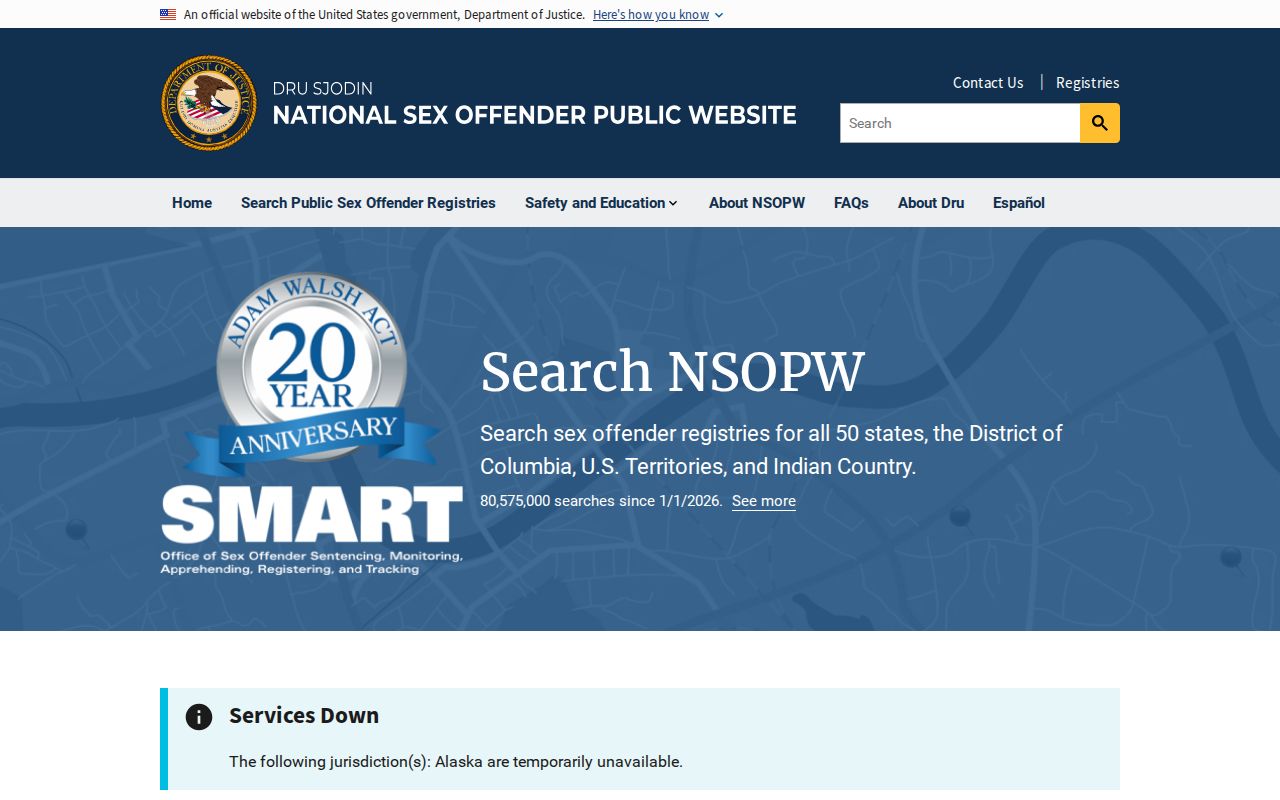
Use it after the Florida search when a record or location may extend beyond the state.
St. Johns Compliance Enforcement
Operation Unified Watch shows how registration records move between agencies. On October 8, 2025, FDLE, the St. Johns County Sheriff's Office, the St. Augustine Police Department, and the Florida Department of Corrections announced 19 arrests for alleged registration violations. The milestone reflects coordinated verification and data exchange, not a public risk-ranking system.
Suspected noncompliance should be reported to local law enforcement. FDLE's registry line is 1-888-357-7332 on weekdays from 8 a.m. to 5 p.m. Do not confront a registrant or try to enforce a registration duty personally.
Community Notification and Lawful Use
Registry data supports awareness, family safety planning, and lawful community notification. It should be used as published, with dates and designations kept intact. A profile is not permission to threaten, harass, intimidate, or publish altered material about a person or household.
Misuse Is a Crime: Florida Statutes §775.21(10)(d) makes specified misuse, including knowingly publishing false public-record information or materially altering it to misrepresent, a first-degree misdemeanor. Never harass, threaten, intimidate, or take vigilante action against a registrant or household.
When a record looks wrong, report the concern through FDLE or local law enforcement. Preserve the profile URL and note the address source and received date. That gives the agency a precise record to review while keeping the response within lawful channels.