
St. Johns County Criminal Court Cases
Two trial-court levels divide the local criminal docket. Circuit Court in Florida's Seventh Judicial Circuit hears felonies. County Court hears misdemeanors, criminal traffic, county ordinances, and municipal ordinances. The 2026 assignment order places circuit felony work in Division 56 and felony Drug Court matters in Division 26. County misdemeanor work is divided among Divisions 65, 66, and 67. Assignments can change, so verify the division through the Seventh Judicial Circuit judges overview before a hearing or counter visit.
The St. Johns County Clerk of the Circuit Court and County Comptroller keeps the docket, filings, hearing data, judgments, and sentences. City ordinance cases also reach County Court rather than a separate municipal criminal court. That makes the Clerk the right custodian for the final outcome. Police reports and arrest affidavits may begin with SJSO or a city police department, but those agencies do not certify the court's disposition.
St. Johns Benchmark Search Modes
The Clerk's Benchmark portal gives St. Johns County criminal case researchers three routes: Name, Case Number, and Citation Number. Name searches use the displayed “Last, First” format. An exact case number is usually the cleanest key because it avoids common-name matches. The portal's noncivil example combines a two-digit year, a six-digit sequence, and a case-type suffix such as CF.
The St. Johns Court Records Search works anonymously for the public. Filters include opened and closed date ranges, court type, and a dependent cause-of-action or case-type control. Court choices include Criminal Felony, Misdemeanor, Criminal Traffic, County Ordinance, Municipal Ordinance, and Fugitive Justice. Clerk data is described as real time, though a new arrest may still precede the filing of a case.
The official Benchmark screen shows why picking the right mode matters before reading a St. Johns County docket.
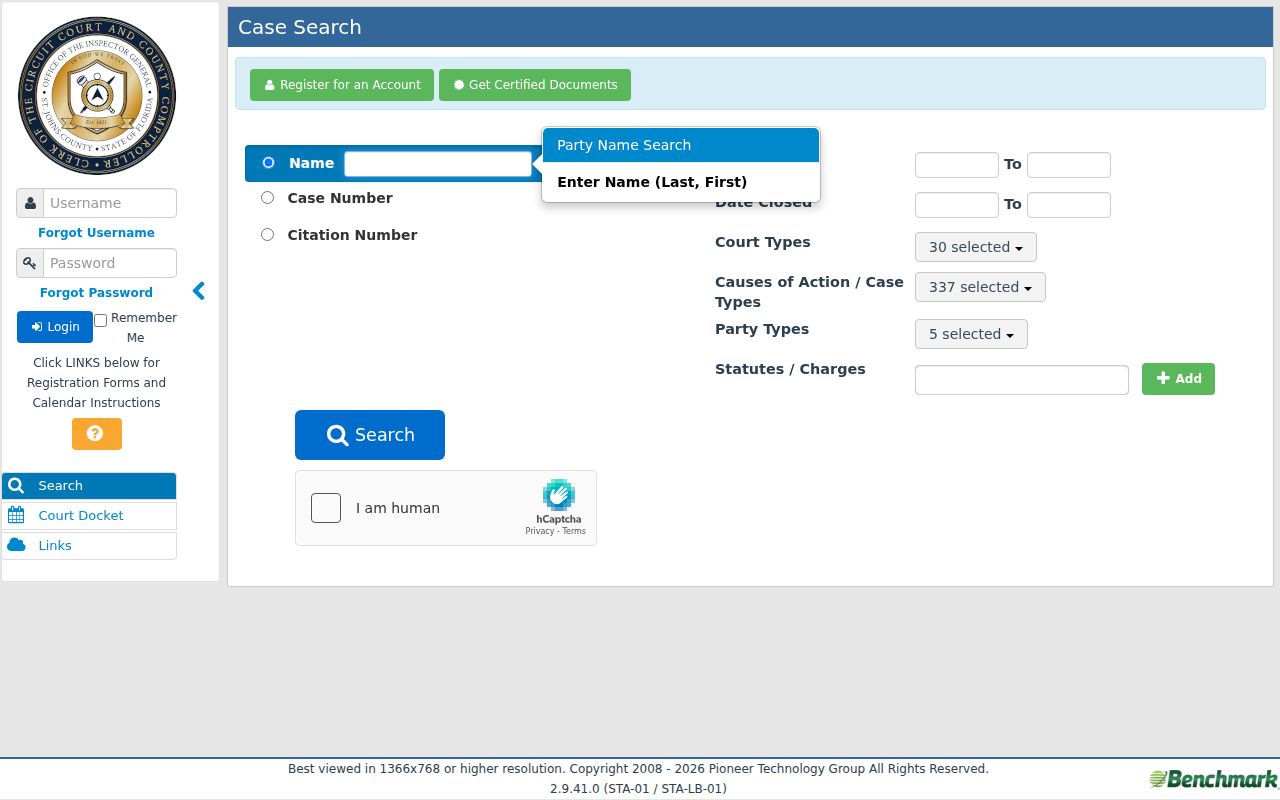
The search controls help separate a filed court case from the broader set of police and booking records tied to the same event.
Searching St. Johns County Case Records
Start online for a modern St. Johns County criminal docket. The public system generally covers computerized records from the 1990s forward, plus older matters that were active during conversion. Search one charge and one defendant carefully. Filed charges can differ from booked charges, and each count may end with a different result.
- Open Benchmark and select Name, Case Number, or Citation Number.
- Enter the exact number when known, or format a party name as “Last, First.”
- Narrow the dates and select the criminal court type that fits the charge.
- Open the docket, inspect each count, and read the last disposition and sentence entries.
- Download released images, or ask the Clerk for a paper or certified copy when authentication is needed.
The portal exposes these practical search controls for St. Johns County criminal cases.
| Field Label | Type | Required | Notes |
|---|---|---|---|
| Name | Text | No | Use “Last, First” |
| Case Number | Text | No | Year, six-digit sequence, and type suffix |
| Citation Number | Text | No | Useful for traffic and citation matters |
| Date Opened / Closed | Date | No | From and To date pickers |
| Court Types | Multi-select | No | Choose the matching criminal category |
Missing St. Johns Criminal Archives
An empty web result does not prove that an older St. Johns County criminal case never existed. Archival criminal and civil material from 1821 to the computerized conversion is generally absent from the public web index, except for cases that remained active during conversion. The Richard O. Watson Judicial Center has public terminals that can reach scans not exposed remotely. A direct Clerk request is the other route.
The criminal research form asks for the subject's name, aliases, date of birth, approximate filing year, case number when known, and the copies or certification sought. A search without a case number costs $2 per name per year. Paper copies cost $1 per page, and certification costs $2 per document. A letterhead search statement costs $7. E-Certify adds $6 per document. These charges differ because viewing, copying, and proving authenticity are separate services.
Note: Search the terminal or submit a narrow year range before concluding that a St. Johns County archive is missing.
Inside a St. Johns County Case File
A St. Johns County case file is organized around prosecution in court, not jail intake. Its header identifies the court, division, case number, filing date, case type, and status. Party entries identify the State of Florida, defendant, and docketed counsel. Charge rows should be read one at a time because the statute, degree, plea, and outcome can vary by count. Images may include the information or indictment, motions, notices, orders, judgment, and sentence, unless a document is confidential or sealed.
| Case Number & Court | Filing year, sequence, case type, division, and open or closed status |
|---|---|
| Charging Document | Information, indictment, or complaint stating charges filed in court |
| Docket Entries | Chronological filings, pleas, motions, warrants, hearings, and orders |
| Hearing Dates | Date, time, event type, location or division, and judge |
| Disposition & Judgment | Outcome for each charge, including dismissal, acquittal, or adjudication |
| Sentence & Conditions | Custody, probation, restitution, assessments, and other court terms |
The Clerk Criminal Division explains online research, copies, and its counter services. Its official page also illustrates the office that maintains these St. Johns County court records.
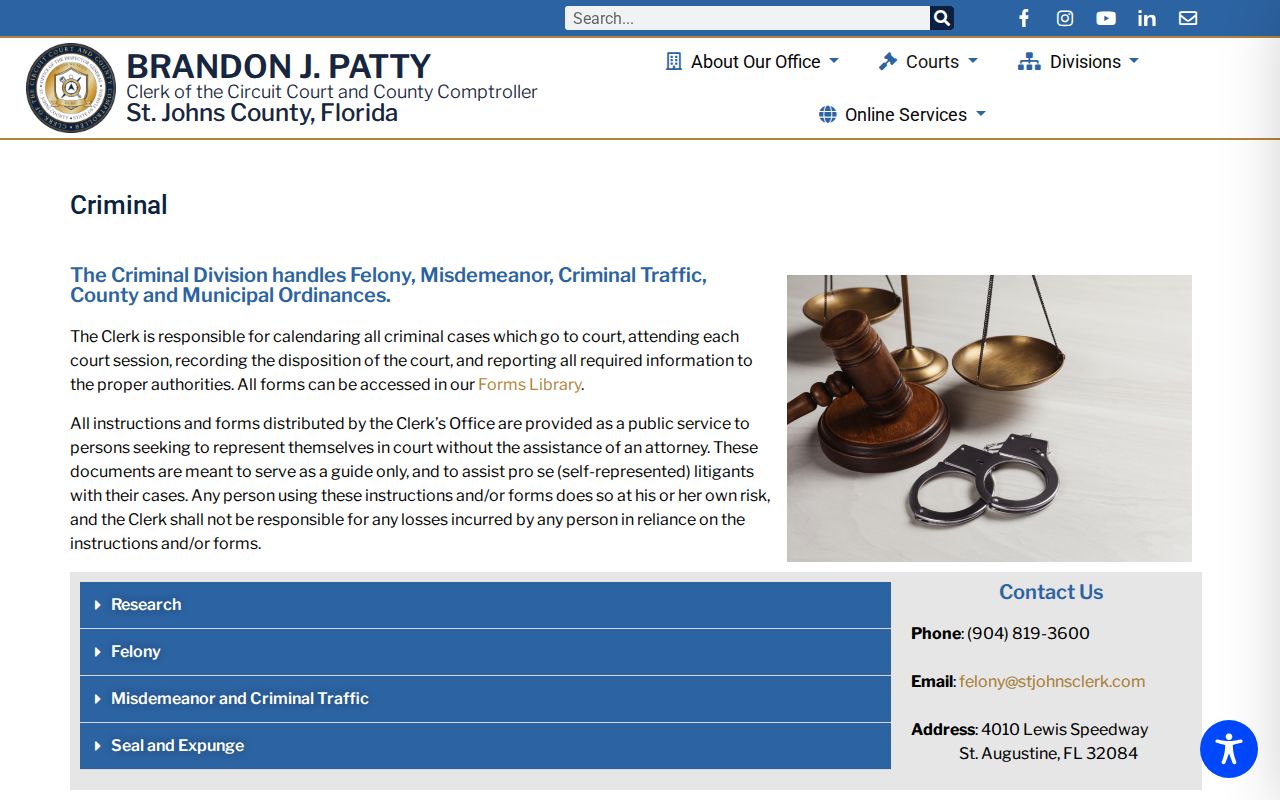
The division is the source for certified dispositions when a portal printout is not enough.
Reading St. Johns Case Outcomes
The last docket line is not always the outcome. Look for a disposition attached to each charge. “Nolle prosequi” means the prosecutor formally stopped that charge. A dismissal ends a charge without conviction, while an acquittal is a not-guilty outcome. “Adjudication withheld” is a Florida result in which the court withholds a formal adjudication of guilt after a plea or finding, subject to legal limits. It is not the same as a dismissal.
A docket can also show a capias, which is a court command to take someone into custody, often after a missed court duty. Active warrant material and supporting affidavits may stay confidential until service or until the warrant is declared unexecutable under Florida court rules. Later return entries may become visible. For a complete reading, match the charging row, plea, judgment, and sentence rather than treating one status label as the whole St. Johns County case.
- Information
- A charging document filed by the prosecutor.
- Disposition
- The outcome of a charge or case.
- Docket
- The dated register of filings and court events.
- Capias
- A court order directing that a person be taken into custody.
How a Criminal Case Moves
After an arrest, the State Attorney decides which charges to file. The Clerk then opens the St. Johns County criminal case and records the charging document. At arraignment, the accused is informed of the filed charges and enters a plea. Pretrial work can add discovery notices, motions, hearings, amended charges, and plea talks. A plea or trial produces the disposition. If there is a conviction or another sentence-authorizing result, the judge records custody, probation, financial terms, or other conditions.
Case flow: Charges Filed › Arraignment › Pretrial › Plea or Trial › Disposition › Sentencing
This sequence explains why a booking charge can differ from the charge that appears later. The St. Johns County arrest lookup follows the agency and jail record, while the court docket follows the filed prosecution.
St. Johns Specialty Court Divisions
Some St. Johns County criminal cases move through a named problem-solving division. The 2026 assignment order routes felony Drug Court work to Division 26 and Veterans Treatment Court matters to Division 27. These are court assignments, not separate record systems. Their motions, hearings, orders, and final results still belong in the Clerk docket under the case number.
A specialty label does not reveal eligibility or success by itself. Read the docket for admission orders, program events, violations, termination, and the ultimate disposition. Juvenile delinquency is assigned separately to Division 46, and those records face confidentiality limits. This division map helps a reader understand where a hearing occurs without assuming every court file is public in full.
Federal Cases Beyond St. Johns Court
Conduct prosecuted in federal court will not appear as a complete case in Benchmark. St. Johns County falls within the Jacksonville Division of the U.S. District Court for the Middle District of Florida. Federal dockets and filed documents run through PACER after registration. PACER charges $0.10 per page, caps most case documents at $3, and waives quarterly bills of $30 or less under its 2026 schedule.
The official PACER source shows the separate federal channel used when a local name search cannot locate a federal prosecution.
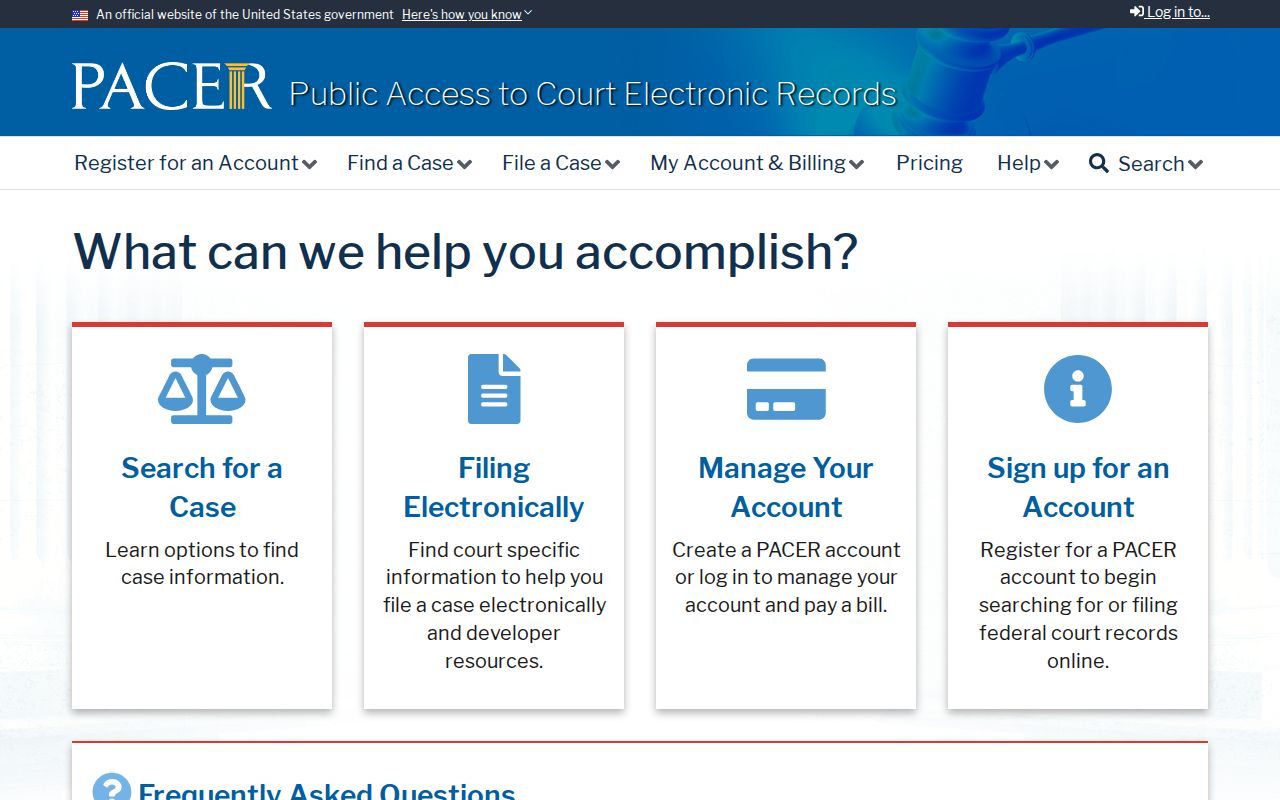
This federal layer supplements, but does not replace, the St. Johns County Clerk docket for Circuit and County Court cases.
Case Record Access & Restrictions
Florida Rule of General Practice and Judicial Administration 2.420 makes judicial records public unless a rule, statute, or court order makes them confidential. Public access does not expose every page. Juvenile files, sealed or expunged cases, protected victim and minor information, confidential identifiers, and active warrant affidavits can be withheld or redacted. A broad request cannot override those limits.
When a St. Johns County case is absent online, ask the Clerk whether the issue is age, conversion, confidentiality, or a search mismatch. Use the Watson Center terminals for archival scans and the criminal research form for a focused search. Available online images may be viewed and printed without charge, while certified copies carry the published fees. A certification verifies the Clerk's document; it does not make a confidential record public.