
St. Johns County Arrest History
St. Johns County Sheriff's Office deputies, St. Augustine police, St. Augustine Beach police, Florida Highway Patrol troopers, FDLE agents, and Florida School for the Deaf and Blind campus police can create local arrest records. The arresting agency writes the incident report or affidavit. SJSO's Main Detention Unit then creates the booking entry for county custody, even when a city officer made the arrest.
An arrest history is not one master file. Booking data proves that intake occurred. The police report explains the alleged event. The State Attorney may file different charges, and the Clerk records the court result. SJSO's local records check covers ten years of arrest records submitted by county law-enforcement agencies. It excludes non-arrest contacts and is expressly not a complete criminal history. FDLE provides the broader Florida repository search.
When St. Johns Jail Search Is Down
The SJSO inmate search displayed a temporary-down notice when researched on July 17, 2026. Do not treat an unavailable roster or an empty page as proof that no booking exists. Call Booking at (904) 209-3125 for current custody and bond, submit a focused request for the booking report, and search the Clerk after prosecutors open a court case.
The official page captures both the St. Johns County lookup channel and the need for a working fallback.
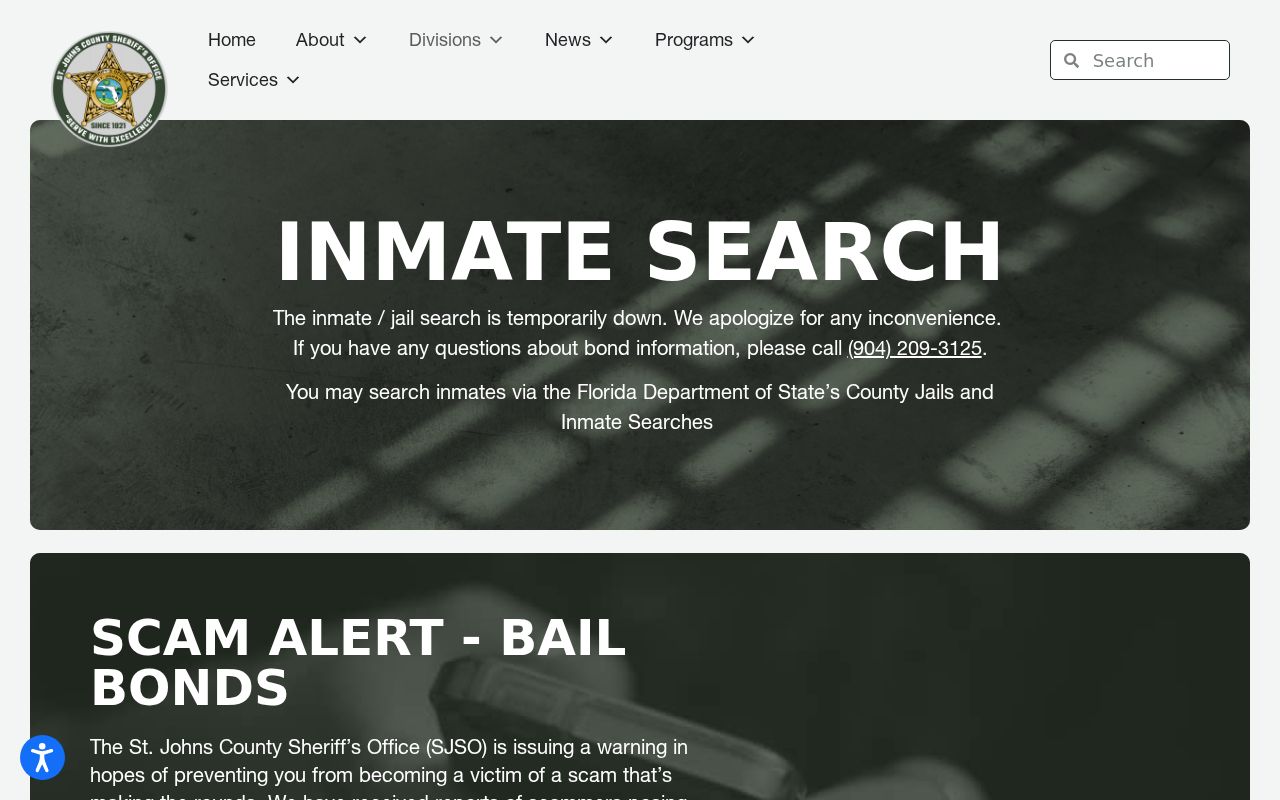
Because live status can change fast, the Booking phone line is the more direct source for a person's current custody or bond amount.
Looking Up St. Johns County Arrests
A complete St. Johns County arrest lookup moves from the freshest custody source to the record custodian and then to the court outcome. Use exact names, date of birth when an official form requires it, the event date, arresting agency, and report or booking number. A recent arrest may not yet have a court case.
- Check the SJSO inmate page. If it is unavailable, call Booking at (904) 209-3125 for custody and bond.
- Identify the arresting agency and request its arrest affidavit or incident report. Do not ask SJSO for a city report it did not create.
- Search the Clerk's Benchmark docket for filed charges, hearing dates, disposition, and sentence.
- Use the FDLE Florida Criminal History Record Check for a statewide public name search, or Personal Review to check your own record with fingerprints.
- When public screens fail, use the SJSO portal, records@sjso.org, (904) 810-6610, or mail a narrow request to the Records Unit.
Note: A new St. Johns County booking may appear before the State Attorney files any charge in court.
St. Johns Arrest Report Requests
The SJSO Public Records Unit Online Portal handles incident reports, address searches, body-worn-camera footage, local checks, and crash reports. Online requests receive tracking, technician messages, and email updates. If the portal is not practical, send email to records@sjso.org, call (904) 810-6610, or mail SJSO Records at 900 Law Enforcement Way, St. Augustine, FL 32092.
Frame the request with involved names, incident date and approximate time, location, report number if known, arresting agency, and the exact item sought. SJSO warns that broad requests can take longer and cost more. Work is handled first come, first served, and the agency gives an estimate before significant charges. Payment is available through its Square channel online or in person.
The official request page shows the channels used to obtain St. Johns County arrest material that is not in a live roster.
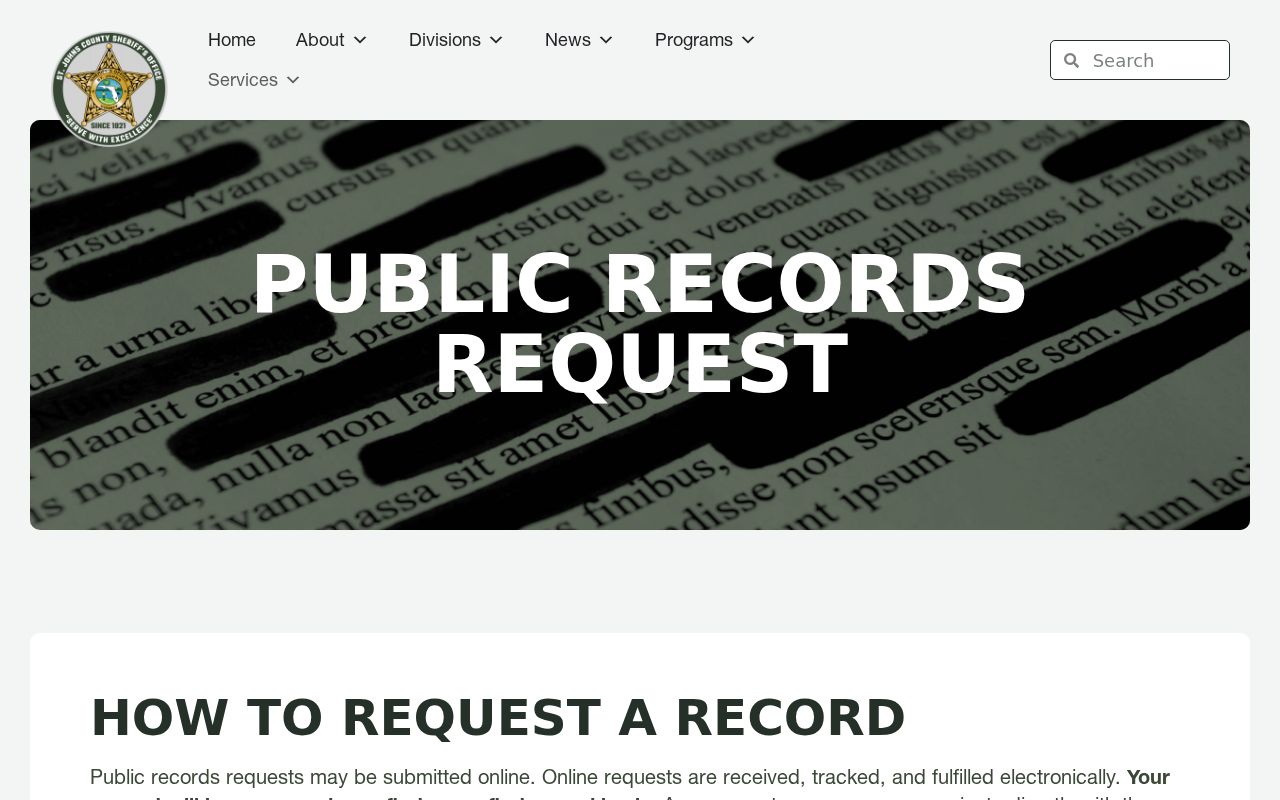
Tracking a focused request is especially useful when a booking screen is down or an older report has rolled out of current custody results.
Inside a St. Johns County Arrest Record
A St. Johns County booking entry centers on intake and custody. Common fields include report or offense number, booking number, arrest date and place, arresting agency, booked charges, statute or code, offense degree, bond, facility, and release status. The arrest affidavit may add the officer's narrative and probable-cause facts. Protected victim, juvenile, and confidential identifier data can be redacted.
| Booking Number | The jail's unique intake key for the custody event |
|---|---|
| Booking Date & Time | When the Main Detention Unit entered the person |
| Arresting Agency | The sheriff, city police, state, or campus agency that made the arrest |
| Charges | Allegations recorded at booking, which may differ from charges later filed |
| Bond | Current cash, surety, or release conditions when publicly available |
| Booking Photo | An intake image if lawfully released by the official custodian |
| Release Status | Custody, transfer, or release information at the time of the record |
Use these fields to match the right event, then check the filed case. Similar names are not enough. Date, agency, booking number, and case number provide a safer chain.
St. Johns Arresting Agency Routes
SJSO booking does not make the sheriff the custodian of every police report. St. Augustine Police Department keeps its reports at 151 King Street and routes requests through SAPD NextRequest or its weekday records counter. St. Augustine Beach Police Department uses NextRequest, contact@sabpd.org, phone, fax, and its counter at 2300 A1A South. The beach department advises allowing seven to ten business days.
Florida Highway Patrol and FLHSMV handle their crash and investigation records. FDLE handles its own investigations and the statewide history product. Florida School for the Deaf and Blind campus police also maintains agency-created records. Ask the agency that authored the report, then use SJSO for booking and the Clerk for the prosecution. This split prevents a common St. Johns County dead end.
Booking Logs and Recent Arrests
The SJSO inmate page is the official public starting point for current St. Johns County detention, but its posted outage makes the alternate channels vital. SJSO news releases describe selected activity, not a complete blotter. Neither source should be treated as a permanent arrest history. Call Booking for live custody or bond, and request the booking report when a public page cannot supply the event.
Rosters are built for present or recent custody. Entries can change after release, transfer, a bond decision, or a corrected charge. A person may also be booked by SJSO after an arrest by city or state officers. Absence from a current roster proves nothing about an older arrest. The ten-year local check, agency report, Clerk docket, and FDLE record each fill a different part of that gap.
Use the booking number as the bridge when one is available. It can help SJSO locate the correct custody event, while the arrest date and agency help the Clerk match a later filing. If the person moved into state prison or felony supervision, the Florida Department of Corrections Offender Information Search becomes the right custody channel. It does not replace the county booking report or prove the outcome of every booked count.
St. Johns Booking to First Appearance
At the Main Detention Unit, SJSO enters the arrested person into its system, takes fingerprints and a photograph, and records booked charges. The unit has a stated capacity of 664 and processes county arrestees while holding men and women awaiting pretrial proceedings. Its Community Work Release Center has a separate capacity of 100 for eligible men serving county jail terms of 364 days or fewer.
First appearance occurs seven days a week, usually between 7:30 and 11:00 a.m. The judge reviews the charging affidavit for probable cause and sets bond when appropriate. Full cash bond may be posted at the jail, or a licensed bondsman may be used. Actual hearing time and current bond should be confirmed with Booking because the record can change after the initial entry.
The SJSO corrections contact page separates custody communication from arrest-record research.
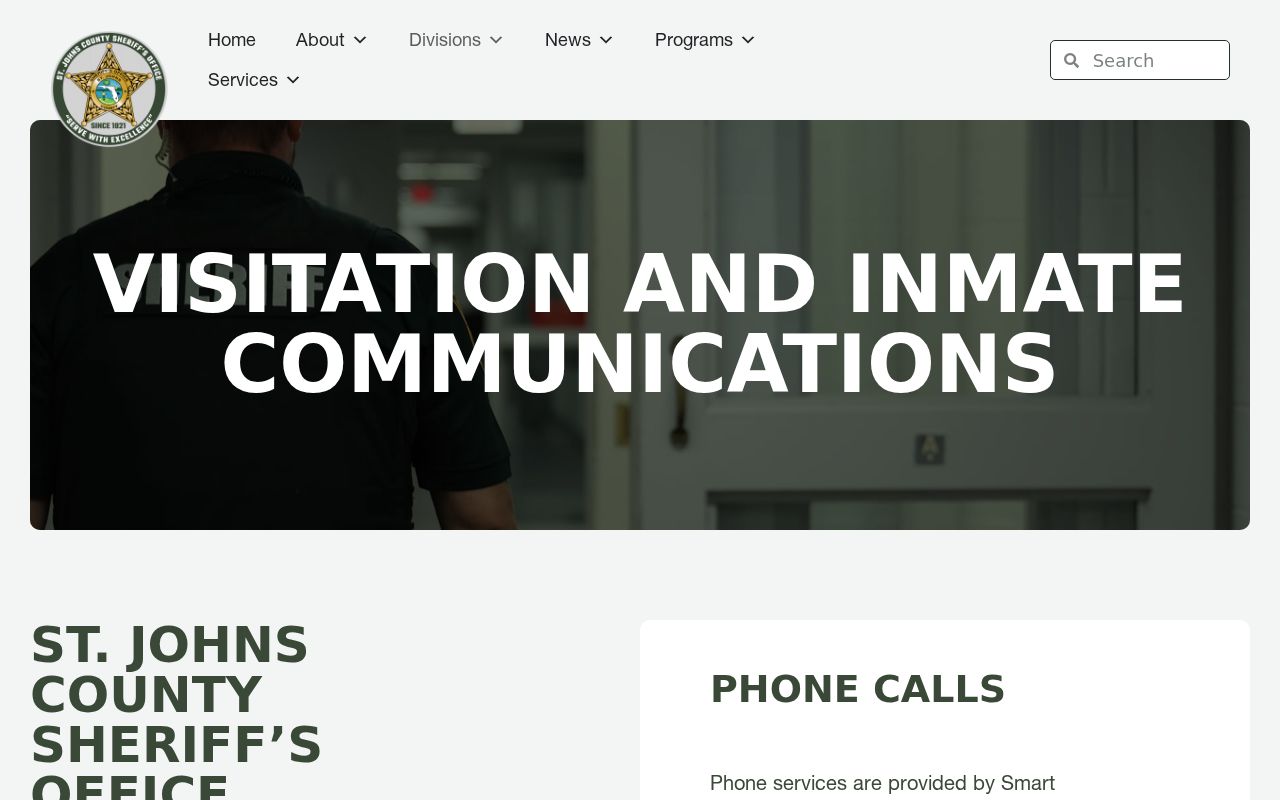
Contact services help families reach a person in custody, while Booking and Records remain the channels for arrest status and reports.
Ten-Year St. Johns Arrest Check
SJSO's local check is narrow by design. It searches ten years of St. Johns County arrests submitted to the sheriff by county law-enforcement agencies. It does not list contacts that ended without arrest, and it is not a complete Florida criminal history. Research exceeding fifteen minutes carries a $10 fee.
The official form requires first, middle, and last names, a suffix or “None,” address, sex, race, date of birth, Social Security number, driver-license number and state, plus requestor details. Sensitive fields belong only in the official portal. For a statewide name-based result, use the FDLE Florida Criminal History Record Check, which costs $24 plus a $1 card fee for Instant Search. For self-review and accuracy work, FDLE offers a free fingerprint-supported Personal Review and challenge route.
These products should not be merged into one result. The St. Johns County check is local and arrest-only. FDLE draws on reporting from across Florida, yet its public name search is not fingerprint verified and may omit confidential material. Personal Review uses fingerprints to help the subject find identity errors, missing dispositions, or reporting gaps. If a dismissal or other outcome is absent, compare the Clerk docket first and then use FDLE's challenge process with the supporting court record.
Arrests Are Not Convictions
An arrest means an agency took a person into custody and the jail recorded booked allegations. It does not establish guilt. Prosecutors may decline a charge, file a different charge, or later stop prosecution. A court may dismiss a count or enter an acquittal. Only the court docket shows the judicial result, and the St. Johns County criminal court cases provide the filed charge, disposition, judgment, and sentence.
| Arrest Record | Conviction Record |
|---|---|
| Created by the arresting agency and jail | Created and maintained by the court and Clerk |
| Shows that an arrest and booking occurred | Shows the court's finding and final result |
| Lives with the agency, SJSO booking, and repository reporting | Lives in the Clerk docket and reported disposition data |
| May lead to release, no filing, dismissal, or a case | May lead to sentence, appeal, sealing, or expunction |
Note: A St. Johns County arrest is not proof of guilt, and a booking may end without any conviction.